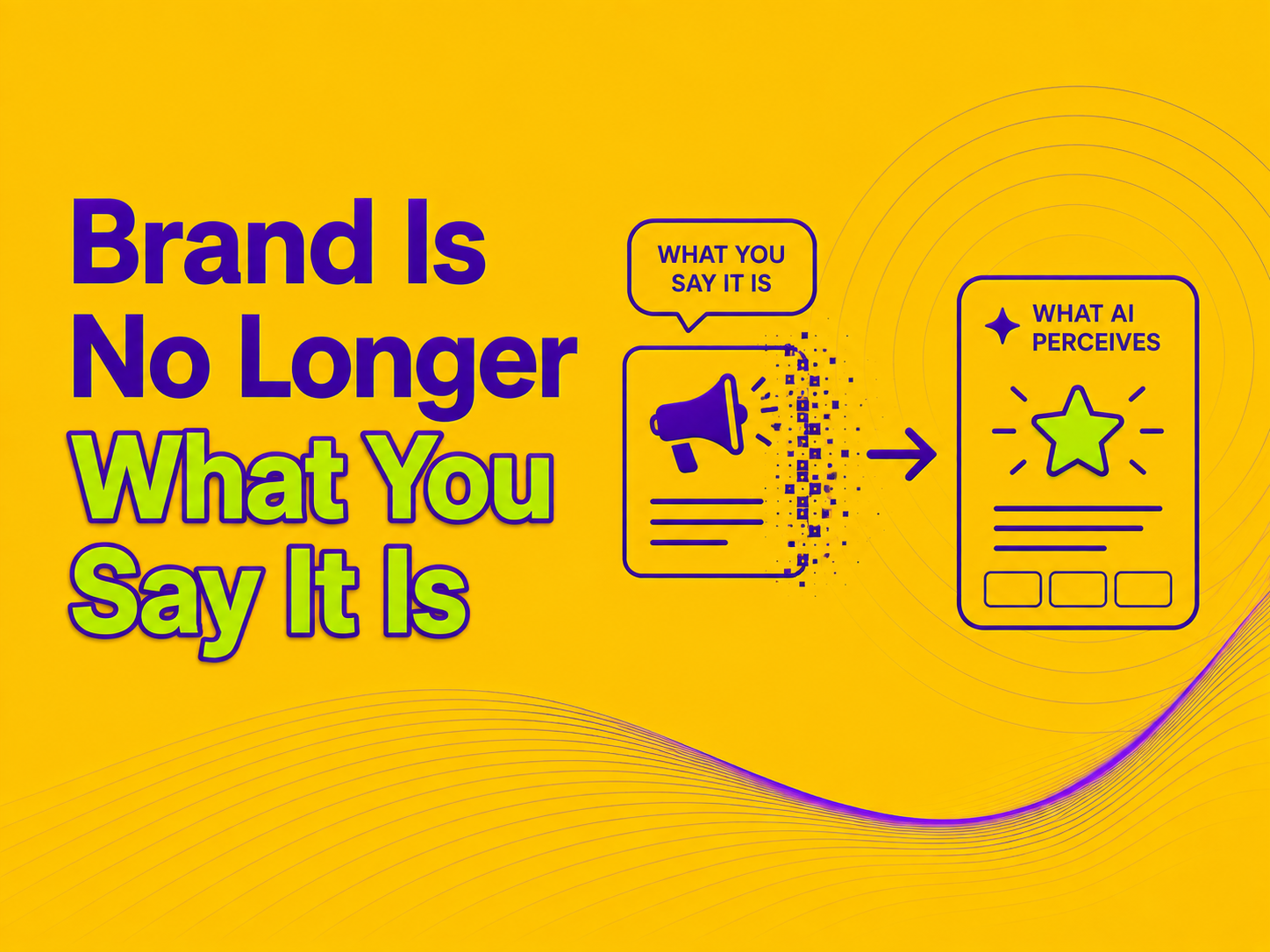
Your Brand Is No Longer What You Say It Is
For a long time, companies had a relatively simple way to think about brand.
You decide what you want to stand for. Then you communicate it.
Positioning.
Messaging.
Campaigns.
PR.
Content.
Repeat.
But there is a new participant in the brand conversation:
AI.
And it doesn't care what your brand guidelines say.
Ask AI what your company is
Try this with your own company.
Ask ChatGPT:
"What is [company] known for?"
Then ask:
"What are its strengths and weaknesses?"
Then:
"Who are its main competitors?"
You might be surprised by the answers.
Because the AI isn't reading your brand book.
It's building an understanding of your company from the information available across the internet.
• Your website.
• News.
• Reviews.
• Social media.
• Third-party articles.
• Forums.
• Other companies.
• And the way people talk about you.
Your brand now has an AI interpretation.
That's a different kind of brand problem
Imagine your company says:
"We are the most innovative platform in our category."
But AI consistently describes you as:
"A low-cost alternative to the market leader."
Which one is your brand?
The uncomfortable answer is:
Both.
Your positioning is what you want people to believe.
Your reputation is what people actually believe.
And AI is becoming another layer through which that reputation gets interpreted.
This makes consistency more important
I'm not talking about making every piece of content sound identical.
I'm talking about coherence.
If your website says one thing, your executives say another, your customers experience something else and the wider internet describes you differently, AI has to make sense of the contradiction.
And it will.
It will simply construct its own answer.
This is why brand is increasingly becoming an information architecture problem.
What do you say?
What do others say?
What evidence supports it?
What does your product actually deliver?
Are all those signals pointing in roughly the same direction?
The answer isn't to optimize your brand for AI
I wouldn't recommend trying to "hack" how AI describes you.
That misses the point.
The better question is:
Would an intelligent third party describe us the way we describe ourselves?
If the answer is no, you have a brand problem.
Not an AI problem.
AI is simply making the gap easier to see.
Brand used to be broadcast. Now it is interpreted.
This is the bigger shift.
Marketing has traditionally been about controlling the message.
But control is becoming harder.
Customers create content.
Employees create content.
Creators create content.
Communities create content.
AI systems summarize all of it.
Your brand is no longer just what your company publishes.
It's the pattern that emerges from everything people can find about you.
That's both exciting and uncomfortable.
So what should marketers do?
Three things.
First, create a clear point of view.
If you don't know what you want to be known for, you can't expect an AI or a customer to figure it out for you.
Second, make the product support the story.
The strongest brand claims have evidence behind them.
Third, look outside your own channels.
Search your company.
Ask AI about your company.
Read what customers say.
Look at how journalists describe you.
See what competitors say about you.
You might discover that your brand is already telling you something.
The new brand question
The old question was:
"What do we want people to think about us?"
The new question is:
"What does the world, and increasingly AI, understand about us?"
The gap between those two answers is where brand strategy gets interesting.
Because ultimately, you can't completely control your brand.
You can only make the story clear, consistent and credible enough that other people, and now machines, have a reason to repeat it.
**Your brand isn't just what you say anymore.
It's what gets understood.**