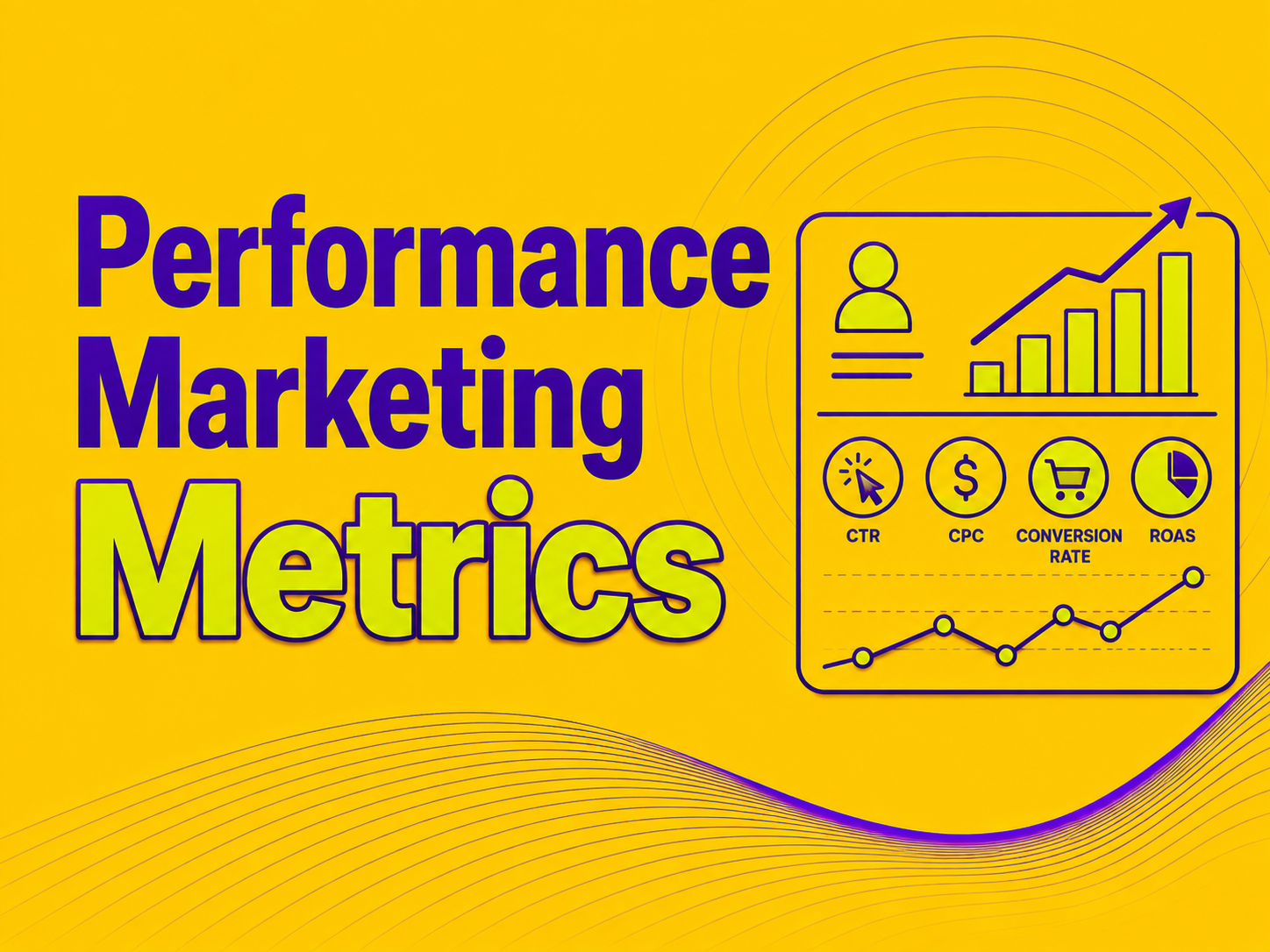
Performance Marketing Metrics: What Should Marketers Actually Measure?
Marketing has never had more data. We can measure almost everything: clicks, impressions, conversion rates, CAC, ROAS, LTV, engagement, retention.
And yet, I sometimes think we're getting worse at answering the simplest question:
Is marketing actually making the business better?
More data doesn't automatically mean better decisions. Sometimes it just means more dashboards.
The problem with performance marketing metrics
Most performance marketing metrics are useful. The problem is what we do with them.
A campaign gets a 5x ROAS and everyone celebrates. But what if those customers have terrible retention? Or the campaign is mostly capturing people who were already going to buy? Or we're spending more and more to find the same audience?
A metric can be completely accurate and still tell an incomplete story.
The goal isn't to measure everything. It's to measure what matters.
Start with the business, not the dashboard
Before choosing your marketing KPIs, ask one simple question:
What are we actually trying to improve?
If the answer is revenue, your metrics should connect to revenue. If it's profitable growth, measure profitability. If it's customer acquisition, understand CAC and customer quality. If it's creating a new category, brand awareness and consideration may matter more than immediate conversion.
It sounds obvious, but marketers often start with the metrics available in the platform rather than the outcomes the business actually needs.
The metrics that matter
I like to think about performance marketing metrics in four layers.
Attention
First, are we reaching the right people?
Metrics like impressions, reach, CTR, CPC and engagement can tell us whether the creative, audience and channel are doing their job.
But don't confuse attention with demand.
A million impressions aren't particularly valuable if nobody remembers you.
Acquisition
Then comes the obvious question: Are people taking action?
This is where conversion rate, CPA and CAC become important.
CAC is particularly useful because it forces marketers to connect spending with actual customers. But CAC is only half the story.
A €50 customer acquisition cost can be fantastic. Or terrible.
It depends on what that customer is worth.
Customer value
This is where marketing metrics become more interesting.
LTV, retention, repeat purchase rate and payback period help answer a better question:
Did we acquire a valuable customer?
Imagine two campaigns. Campaign A has a €40 CAC and produces customers worth €60. Campaign B has a €70 CAC and produces customers worth €400.
Which campaign performed better?
If you're only looking at CAC, the answer is obvious.
If you're looking at the business, it isn't.
Cheap acquisition isn't the same as good acquisition.
Incremental growth
And then we get to the metric marketers often struggle with most:
What did marketing actually cause?
This is where incrementality becomes important.
If someone was already going to buy and your ad simply happened to be the last thing they saw, should marketing receive full credit?
Attribution might say yes.
Reality might say no.
This is why tests, holdout groups and incrementality analysis are becoming increasingly important.
Attribution tells you where the conversion was recorded. Incrementality asks whether marketing created the conversion.
That's a much harder question.
It's also a much more valuable one.
What about ROAS?
ROAS is useful.
I just wouldn't let it run the company.
A high ROAS can come from targeting people who already know your brand. It can look great while you're reaching a small pool of existing demand. And it doesn't tell you much about retention, profitability or long-term brand value.
So instead of asking:
"What's our ROAS?"
I'd also ask:
"What's driving it?"
Are we creating demand? Capturing demand? Improving conversion? Reaching better customers? Or simply harvesting people who were already close to buying?
The number matters.
The story behind the number matters more.
The KPI hierarchy I would use
If I had to simplify the performance marketing dashboard, I'd think about it as a journey from business outcomes down to channel activity.
Business outcomes are revenue, profit and growth.
Customer economics are LTV, CAC, payback and retention.
Marketing effectiveness includes incrementality, conversion and acquisition efficiency.
Channel performance includes ROAS, CPA, CPC and CTR.
And at the top of the funnel, you have attention, including reach, impressions and engagement.
The further down you go, the more useful the metrics become for diagnosing what is happening. But the higher up you go, the closer you are to the actual business question.
Don't let the bottom of the funnel become the whole story.
The best marketing KPI is the one that changes a decision
This is probably my favorite test.
If a metric changes tomorrow, would you do something differently?
If yes, it's probably useful.
If no, why are you tracking it?
Marketing teams don't need another hundred KPIs. They need a smaller number of metrics that help them make better decisions.
Because the purpose of measurement isn't to create a beautiful dashboard.
It's to create better marketing.
And ultimately, better marketing should create a better business.
That is the metric that matters most.