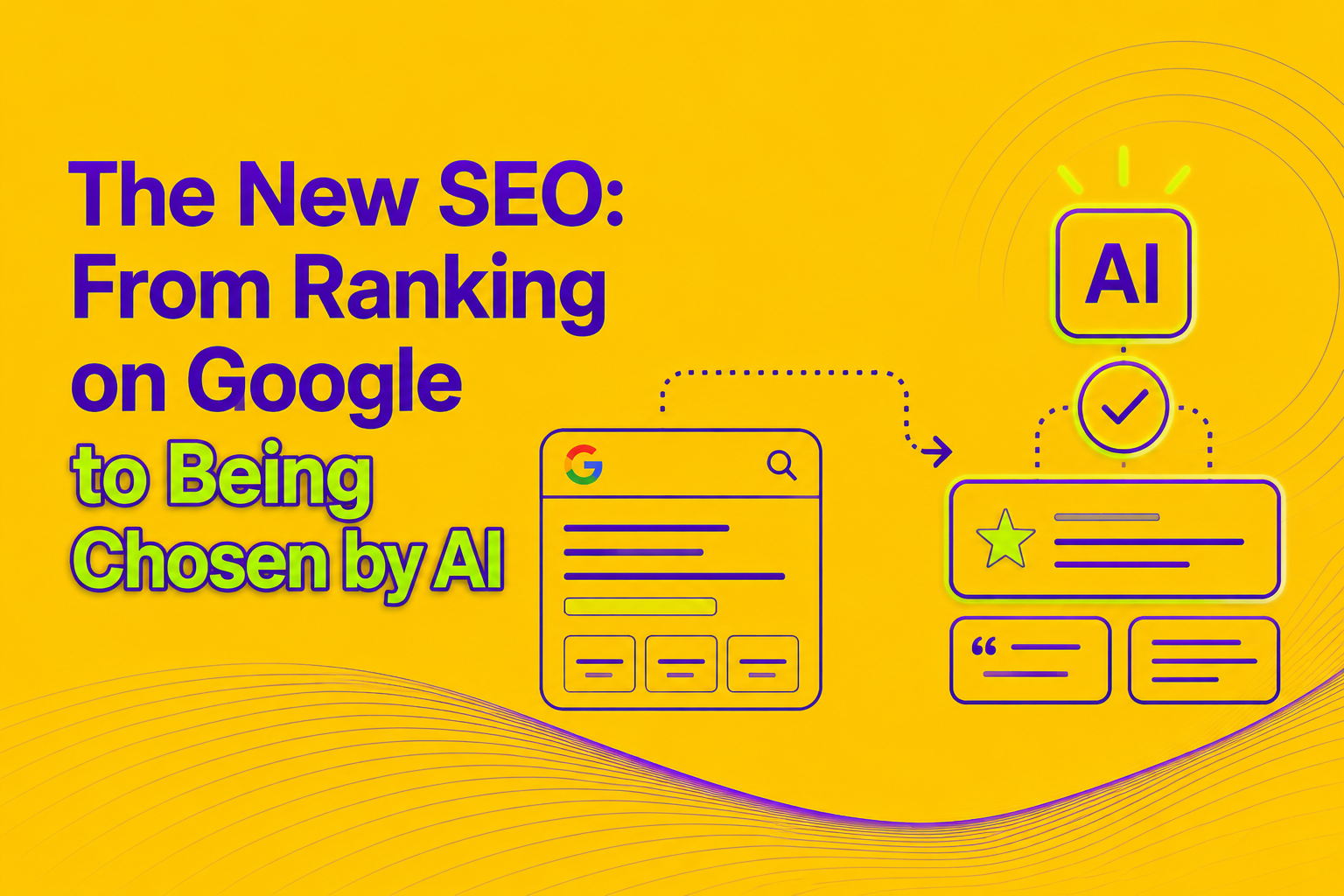
The New SEO: From Ranking on Google to Being Chosen by AI
For years, SEO had a relatively simple objective: get your page to rank as high as possible on Google.
The higher you ranked, the more likely someone was to click.
That model is changing.
Search is moving from a list of links toward answers generated by AI. Google has AI Overviews. ChatGPT, Perplexity and other AI systems can answer questions directly. Increasingly, people don't just search for a website. They ask a system to make sense of the web for them.
That creates a new marketing question:
How do you become one of the sources AI chooses to trust?
From ranking to being referenced
Traditional SEO is fundamentally about position.
You want to be number one, or at least visible on the first page.
AI search introduces a different dynamic. A model may use information from multiple sources to construct an answer, sometimes mentioning or citing only a few of them.
The objective is therefore shifting from:
"How do I rank?"
to:
"How do I become a trusted source for the answer?"
That sounds like a small distinction. It isn't.
Ranking rewards relevance and optimization.
Being referenced requires something closer to authority and usefulness.
The content game is changing
This doesn't mean traditional SEO is dead. Technical SEO, links, keywords, structure and search intent still matter.
But they are no longer the whole game.
AI systems have an enormous amount of content to choose from. Repeating what everyone else has already said doesn't give them much reason to choose you.
The content that stands out increasingly has something distinctive behind it:
• Original research
• First-hand experience
• Specific expertise
• Strong opinions supported by evidence
• Unique data or examples
• Clear explanations of complicated subjects
I• nformation that is useful enough to be referenced elsewhere
This creates an interesting paradox.
The best way to optimize for AI may be to stop thinking so much about optimization.
If your content exists primarily because you found a keyword with search volume, it is probably going to look a lot like everyone else's content targeting that keyword.
If it exists because you have something genuinely useful to contribute, you have a much better starting point.
Your brand becomes part of the search result
There is another important shift.
In traditional search, the user usually sees your brand after clicking your result.
In AI search, the user may encounter your brand before ever visiting your website.
Imagine someone asks:
"Who are the leading experts in AI search marketing?"
If an AI system mentions your name, you've already entered the consideration set.
There may be no click.
But there is still exposure.
That means brand authority and search visibility are becoming increasingly connected.
Your content doesn't just need to rank.
It needs to help establish what your company or your name is known for.
The new SEO is partly an authority problem
This is why I think the next generation of SEO will be less about producing more content and more about building a coherent information ecosystem.
Your website says one thing.
Your LinkedIn says something related.
Industry publications reference you.
Other experts discuss your ideas.
Your content contains original perspectives.
Your company is consistently associated with a particular area of expertise.
Over time, these signals reinforce each other.
The question isn't simply:
"Can Google find my page?"
It becomes:
"Does the wider web give search engines and AI systems enough reasons to believe I know what I'm talking about?"
That is a much harder problem.
And a much more interesting one.
What marketers should do now
I wouldn't abandon traditional SEO.
I'd expand the definition of it.
Keep optimizing for search engines, but build content with five additional principles:
1. Have a point of view.
Don't just summarize what already exists. Say something.
Don't just summarize what already exists. Say something.
2. Add first-hand knowledge.
Experience is difficult to manufacture at scale.
Experience is difficult to manufacture at scale.
3. Create original information.
Research, data, frameworks, examples and observations give others a reason to reference you.
Research, data, frameworks, examples and observations give others a reason to reference you.
4. Build topical authority.
Ten disconnected articles are less powerful than a coherent body of thinking around a subject.
Ten disconnected articles are less powerful than a coherent body of thinking around a subject.
5. Think beyond your website.
AI visibility is influenced by the broader information environment around your brand.
AI visibility is influenced by the broader information environment around your brand.
The goal isn't to trick an AI into mentioning you.
The goal is to become the kind of source that deserves to be mentioned.
From SEO to information authority
The biggest change may be conceptual.
SEO was built around a world where people searched, scanned results and clicked.
AI search is creating a world where people ask, evaluate and act.
That changes what visibility means.
The future of search isn't just about winning the page. It's about earning a place in the answer.
And for marketers, that means the most valuable optimization may ultimately be the oldest one:
Become genuinely useful.